


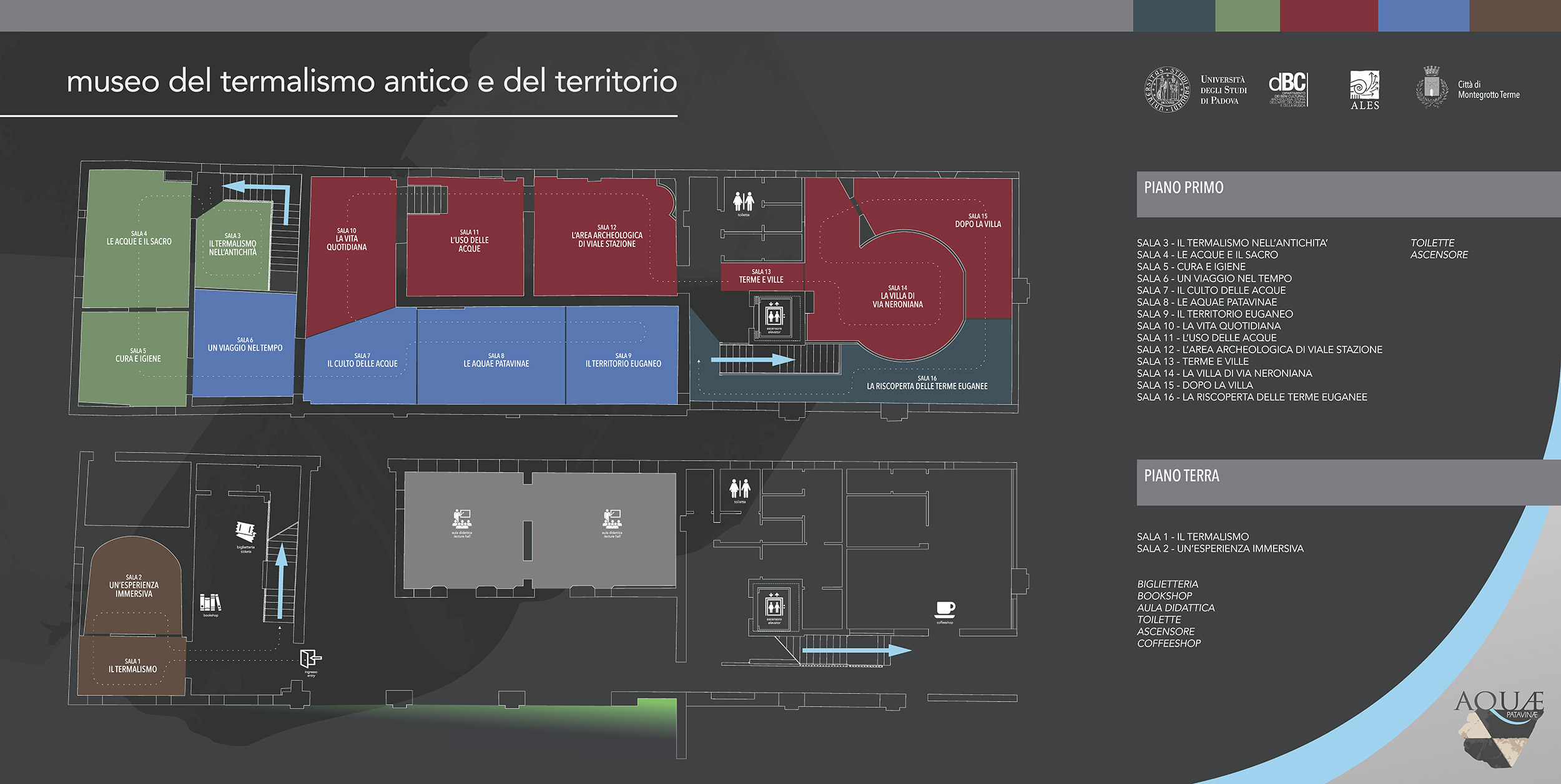


Welcome to museo del termalismo antico e del territorio
The Museo del Termalismo Antico e del Territorio is the first museum in Europe entirely dedicated to the thermal resource, explored through geology, medicine, archaeology, and history. Its halls host and preserve original artifacts from nearby archaeological areas, as well as reproductions of ancient objects found in other sites, together with multimedia installations that make the visit dynamic and immersive.
Suitable for both adults and children, as well as for specialists in the field, the museum is housed within the Villa Draghi complex in Montegrotto Terme, and all its spaces are fully accessible.

Vintage postcard
YEARS OF HISTORY
MULTIMEDIA INSTALLATIONS
FINDINGS
MAY 14th OPENING
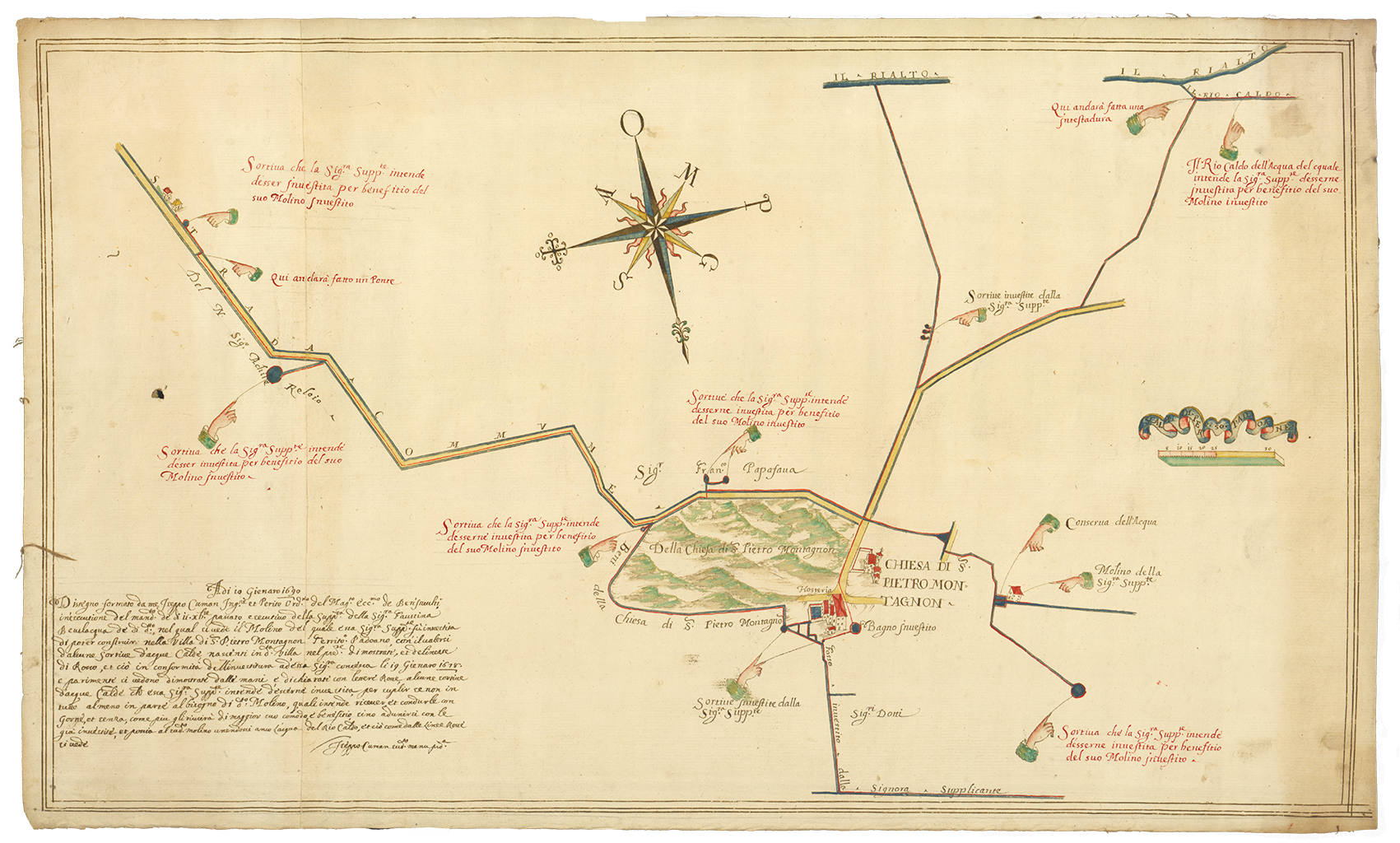
Ancient Map of Montegrotto Terme and its surroundings with thermal spots highlighted
THERMAL-MINERAL WATERS
The journey into the world of thermalism begins by discovering the long and fascinating process through which thermal waters are formed.
|
From the infiltration of rainwater into the subsoil to its transformation and eventual emergence as steam, mineral water and therapeutic mud, thermal water exists in the Euganean Hills thanks to their unique geological structure. In this section you will find the following rooms: |
ANCIENT THERMALISM
In ancient times, thermalism was always surrounded by an aura of sacredness and mystery: the hot, steaming waters were considered evidence of the presence of the divine.
|
Evidence of this belief can be seen in the many ex-votos left in these places, regarded both as sites of worship and healing. These offerings were dedicated to request a cure for oneself or for one’s animals, or to give thanks after receiving it. In this section you will find the following rooms: |
THE EUGANEAN THERMAL BATHS
Evidence of the use of thermal resources by the ancient Venetic communities is clearly visible throughout the territory and testifies to the use of thermal waters as early as the 7th century BC.
|
Near the Montegrotto Town Hall, a thermal spring once naturally flowed from the ground. Numerous artefacts discovered nearby bear witness to this: among them bronze figurines depicting horsemen, worshippers and anatomical parts, as well as original miniature vessels. In this section you will find the following rooms: |
ARCHITECTURE AND ARCHAEOLOGY
The thermal springs of the area were exploited and developed by the Romans as early as the 3rd century BC, also through the construction of a network of aqueducts and underground pipelines.
|
Numerous architectural structures were also built, traces of which can still be seen today in the nearby archaeological areas of Viale Stazione – Via degli Scavi and in the luxurious villa on Via Neroniana, discovered in the 1990s. In this section you will find the following rooms: |
The Rediscovery of Thermal Baths
The long history and tradition of thermal baths as places of healing linked to the supernatural, and later as centres of care and leisure in Roman times, were rediscovered only at the end of the eighteenth century.
|
Thanks to the work Dei bagni di Abano by Salvatore Mandruzzato, the first professor of Thermal Medicine at the University of Padua, and to his scientific approach, a new understanding of thermal baths emerged. In this section you will find the following rooms: |
THERMAL-MINERAL WATERS
The journey into the world of thermalism begins by discovering the long and fascinating process through which thermal waters are formed.
ANCIENT THERMALISM
In ancient times, thermalism was always surrounded by an aura of sacredness and mystery: the hot, steaming waters were considered evidence of the presence of the divine.
THE EUGANEAN THERMAL BATHS
Evidence of the use of thermal resources by the ancient Venetic communities is clearly visible throughout the territory and testifies to the use of thermal waters as early as the 7th century BC.
ARCHITECTURE AND ARCHAEOLOGY
The thermal springs of the area were exploited and developed by the Romans as early as the 3rd century BC, also through the construction of a network of aqueducts and underground pipelines.
The Rediscovery of Thermal Baths
The long history and tradition of thermal baths as places of healing linked to the supernatural, and later as centres of care and leisure in Roman times, were rediscovered only at the end of the eighteenth century.
THERMAL-MINERAL WATERS
From the infiltration of rainwater into the subsoil to its transformation and eventual emergence as steam, mineral water and therapeutic mud, thermal water exists in the Euganean Hills thanks to their unique geological structure.
In this section you will find the following rooms:
• Thermalism
• An immersive experience
ANCIENT THERMALISM
Evidence of this belief can be seen in the many ex-votos left in these places, regarded both as sites of worship and healing. These offerings were dedicated to request a cure for oneself or for one’s animals, or to give thanks after receiving it.
During the Roman age, hygienic baths also developed, becoming true places of social gathering where the search for physical wellbeing was closely connected with psychological and social wellbeing.
In this section you will find the following rooms:
• Thermalism in antiquity
• Water and the sacred
• Care and hygiene
THE EUGANEAN THERMAL BATHS
Near the Montegrotto Town Hall, a thermal spring once naturally flowed from the ground. Numerous artefacts discovered nearby bear witness to this: among them bronze figurines depicting horsemen, worshippers and anatomical parts, as well as original miniature vessels.
This strong connection with thermal waters led the Veneto area, during the Romanisation period, to become part of the Roman network of the Aquae Patavinae.
In this section you will find the following rooms:
• A journey through time
• The cult of water
• The Aquae Patavinae
• The euganean territory
ARCHITECTURE AND ARCHAEOLOGY
Numerous architectural structures were also built, traces of which can still be seen today in the nearby archaeological areas of Viale Stazione – Via degli Scavi and in the luxurious villa on Via Neroniana, discovered in the 1990s.
In this section you will find the following rooms:
• Daily life
• The use of water
• The archaeological area of viale stazione
• Baths and villas
• The villa of via Neroniana
• After the villa
The Rediscovery of Thermal Baths
Thanks to the work Dei bagni di Abano by Salvatore Mandruzzato, the first professor of Thermal Medicine at the University of Padua, and to his scientific approach, a new understanding of thermal baths emerged.
Thermal water began to be seen as a natural resource whose mineral properties generate wellbeing for the body, giving rise to the modern concept of thermalism and turning these waters into an important economic resource.
In this section you will find the following rooms:
• The rediscovery of the euganean thermal baths
Book your visit at the museum
You can book your visit via email at info@museodeltermalismo.it or via whatsapp at the +39 389.0235910. Please specify:
- Your full name
- Your phone number
- Your email
- The day of your visit - dd/mm/yy (check the opening days)
- The preferred time (check the opening hours)
- How many of you will be there (adults and children)
- Tell us If you would like to have a guided tour
- Any other request
You can also call us at +39 389.0235910.
We can't wait to meet you!
