




AN EXHIBITION BEYOND
OF SPACE AND TIME
The flow of thermal water, sacred and beneficial, has marked the appearance of our territory since ancient times. The waterways, pools, and small lakes created by this flow have defined the history, settlements, economic growth, and flourishing of culture in the Euganean area. At the center of everything is the sacred lake, once the cornerstone of thermal activity and the epicenter of the divine dimension.
It is also at the heart of the museum: just as the lake once served as an intermediary with the deity, it now serves as a portal to the heart of the museum's narrative. From the narrative of the baths and their context in antiquity, the lake, projected onto the floor and made interactive at the passage, there transports in the history of the Euganean area and its indissoluble spa tradition.
Thermalism And territory, the two souls of the museum, they are thus not separated, but rather united, from the waters of the sacred lake, exactly as they have always been.
thermal mineral waters
The journey to discover thermalism begins by learning about the long process by which thermal waters are formed.
| From the entry of rainwater into the subsoil to its transformation and release in the form of steam, mineral water, and mud, thermal water is present in the Euganean Hills area by virtue of their specific geological composition.
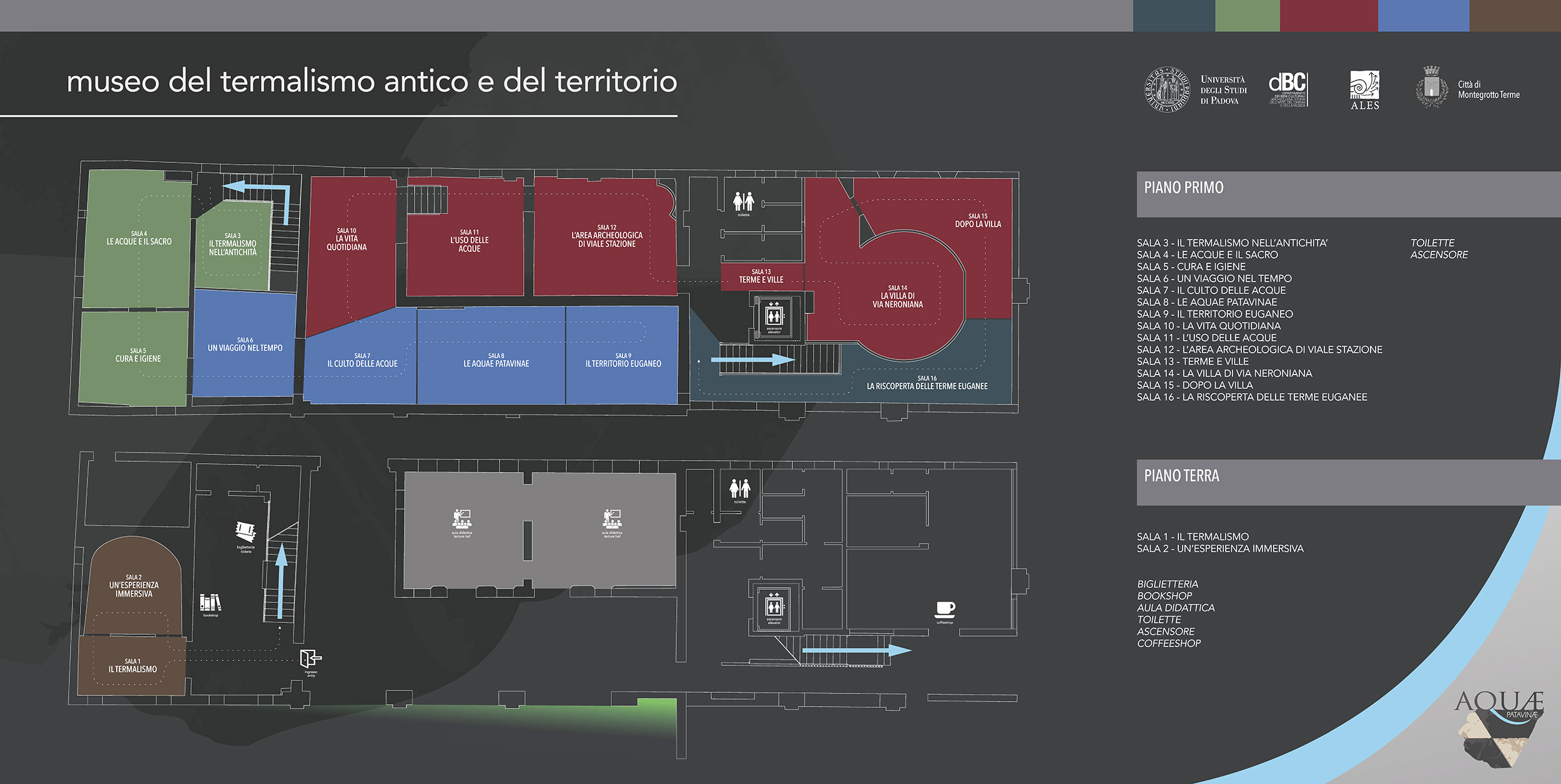
Here you will find the following rooms:
|
ANCIENT THERMALISM
In ancient times, spa treatments were always surrounded by an aura of sacredness and mystery: the hot, steaming waters were in fact considered proof of the presence of the divine.
| Evidence of this is found in the votive offerings left at these places, considered places of worship and healing, to ask for healing for themselves or their animals, or to express gratitude after receiving it. During the Roman era, hygienic baths also developed, true meeting places, where the pursuit of physical well-being intertwined with psychological and social well-being. Here you will find the following rooms:
|
The Euganean spas
Traces of the exploitation of thermal resources by ancient Venetian communities are clearly visible in the area and testify to the use of waters as early as the 7th century BC.
| Near the town hall of Montegrotto, a spring of thermal water flowed naturally from the ground. Numerous artifacts discovered nearby testify to this: among them, copies of bronze statuettes depicting knights, devotees, and anatomical parts, as well as original miniature vases. This connection to the thermal waters led the Veneto region, during the Roman era, to be included in the Roman network of Aquae Patavinae. Here you will find the following rooms:
|
ARCHITECTURE AND ARCHAEOLOGY
The thermal springs in the area were exploited and enhanced by the Romans since the 3rd century BC, also through the construction and development of a network of aqueducts and underground pipes.
| Numerous architectural works were also built, evidence of which is still visible today in the nearby archaeological areas of Viale Stazione-Via degli Scavi and in the luxurious villa on Via Neroniana, discovered in the 1990s. Here you will find the following rooms:
|
THE REDISCOVERY OF THE SPA
The long history and tradition of the spa as a place of healing linked to the supernatural and then as a place of treatment and recreation in Roman times was rediscovered only at the end of the eighteenth century.
| Thanks to the work "Dei bagni di Abano" by Salvatore Mandruzzato, the first professor of Thermal Medicine at the University of Padua, and his scientific approach, the new image of spas as we know them today was born, where the well-being of the body is the result of the intrinsic mineral properties of thermal water, which thus also becomes an economic resource. Here you will find the following rooms:
|
thermal mineral waters
The journey to discover thermalism begins by learning about the long process by which thermal waters are formed.
ANCIENT THERMALISM
In ancient times, spa treatments were always surrounded by an aura of sacredness and mystery: the hot, steaming waters were in fact considered proof of the presence of the divine.
The Euganean spas
Traces of the exploitation of thermal resources by ancient Venetian communities are clearly visible in the area and testify to the use of waters as early as the 7th century BC.
BETWEEN ARCHITECTURE AND ARCHAEOLOGY
The thermal springs in the area were exploited and enhanced by the Romans since the 3rd century BC, also through the construction and development of a network of aqueducts and underground pipes.
THE REDISCOVERY OF THE SPA
The long history and tradition of the spa as a place of healing linked to the supernatural and then as a place of treatment and recreation in Roman times was rediscovered only at the end of the eighteenth century.
thermal mineral waters
From the entry of rainwater into the subsoil to its transformation and release in the form of steam, mineral water, and mud, thermal water is present in the Euganean Hills area by virtue of their specific geological composition.
Here you will find the following rooms:
• Thermalism
• An immersive experience
ANCIENT THERMALISM
Evidence of this is found in the votive offerings left at these places, considered places of worship and healing, to ask for healing for themselves or their animals, or to express gratitude after receiving it. During the Roman era, hygienic baths also developed, true meeting places, where the pursuit of physical well-being intertwined with psychological and social well-being.
Here you will find the following rooms:
• Thermalism in ancient times
• The waters and the sacred
• Care and hygiene
The Euganean spas
Near the town hall of Montegrotto, a spring of thermal water flowed naturally from the ground. Numerous artifacts discovered nearby testify to this: among them, copies of bronze statuettes depicting knights, devotees, and anatomical parts, as well as original miniature vases. This connection to the thermal waters led the Veneto region, during the Roman era, to be included in the Roman network of Aquae Patavinae.
Here you will find the following rooms:
• A journey through time
• The cult of water
• The Aquae Patavinae
• The Euganean territory
BETWEEN ARCHITECTURE AND ARCHAEOLOGY
Numerous architectural works were also built, evidence of which is still visible today in the nearby archaeological areas of Viale Stazione-Via degli Scavi and in the luxurious villa on Via Neroniana, discovered in the 1990s.
Here you will find the following rooms:
• Everyday life
• The use of water
• The archaeological area of Viale Stazione
• Spas and villas
• The villa on Via Neroniana
• After the villa
THE REDISCOVERY OF THE SPA
Thanks to the work "Dei bagni di Abano" by Salvatore Mandruzzato, the first professor of Thermal Medicine at the University of Padua, and his scientific approach, the new image of spas as we know them today was born, where the well-being of the body is the result of the intrinsic mineral properties of thermal water, which thus also becomes an economic resource.
Here you will find the following rooms:
• The rediscovery of the Euganean spas

DOWNLOAD THE MAP
Explore the museum's itineraries
