




Roman baths: thermal spas with hot water and steam created by complex heating systems. Technological inventions that became a way of life. These and many other innovations of Roman genius.
I. Roman Technology and Innovations
The Romans are renowned today as a nation of great technological inventors. Aqueducts, sewers, war machines: Ancient Rome was a true incubator of startups if we want to use a contemporary lexicon.
Many innovations were also introduced from the point of view of daily life:
- they established the first corps of firefighters to contain the frequent fires that plagued the wooden houses in the cities;
- they create the first hospitals for public health care;
- they were the first players of what later became rugby and football in modern times, which at the time was called harpastum and was practiced mainly by gladiators and legionaries.
II. Roman Baths: Life-Changing Technology
Some technological innovations were closely linked to innovations in everyday life. First and foremost was the introduction of artificial baths. Who, imagining life in ancient Rome, doesn't picture vast bathhouses in which to conduct business, converse, and while away the days?
The culture of the spa, considered a fundamental part of a "typical" day, was a Roman introduction. But at the basis of this lifestyle revolution he hides the application of a technological intuition truly sensational.
At the beginning of their history, the Romans had in fact chosen to exploit the natural thermal springs, as had the other peoples of the territory before them. In the imperial era, however, instead of moving towards the thermal areas, the astute Romans decided to move the spas within their large cities.
To compensate for the lack of natural thermal waters in the city, they created a complex water heating system, as well as imposing architectural structures in which to practice the “spa routine”. But how did they do it?
III. The hypocaust
They succeeded in perfecting a Greek invention, that of the hypocaust, a underground room Equipped with a powerful oven that produced extremely hot air. The air was then forced into a hollow space created beneath the interior floor and through pipes behind the walls. This created hot water, steam, and all the phenomena we naturally find in natural thermal baths.
As bathhouses became a symbol of power and wealth, emperors and influential figures aspired to build large, elaborate ones, with numerous suites of rooms, varying temperatures, and a variety of personal care services. And the larger the buildings, the more underground rooms dedicated to heating the water grew, where legions of slaves were tasked with keeping the fires burning and the temperature constant.
The same hypocaust heating system was also used in Roman times in the luxurious villas of influential people. The Romans were in fact the inventors of modern underfloor heating!
IV. A thermal machine at the museum
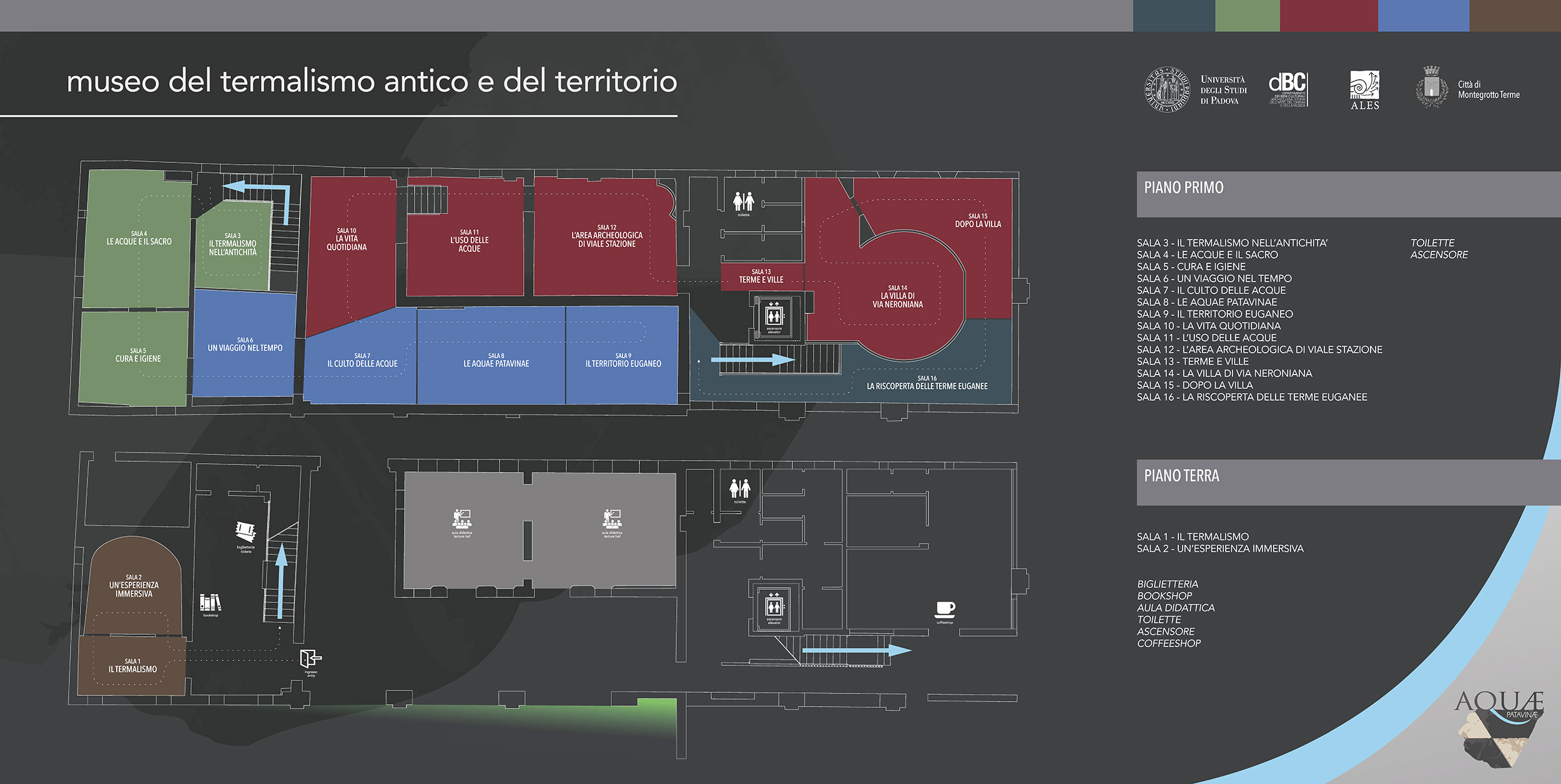
The hot water was then moved inside the thermal structures thanks to complex transport machines. One of these, it was reconstructed at the Museum of ancient thermalism and the territory in an interactive installation, where in addition to observing its structure, you can operate it personally to better understand how it works.
This is a "noria," a wheel-shaped hydraulic machine already known in Roman times. Widely used in thermal baths to transport hot water, it was often equipped with buckets attached to the ends of the spokes that discharged the water into channels. In some cases, it was so massive that it had to be kept in constant motion by a man walking inside it.
Come visit us to operate the noria and discover firsthand all the technology of the Roman baths!
Illustration credits: Alice Walczer Baldinazzo
